
Why Carpenter Ants?
Ants are a very common pest in Massachusetts, but not every ant was created equal. In this article, I will discuss the most common and most important ant, as far as pest control goes, that can be found in New England - the carpenter ant.
We can use crowd-sourced observation data from iNaturalist to get a general idea of how frequently members of the public encounter various animals (pest or otherwise), and it shows that carpenter ants are by far the most numerous, making up 42% of all ant observations. I can also say that they make up the majority of the infestation cases that we deal with, which makes sense given that they are the only kind of ant capable of causing real damage to property.
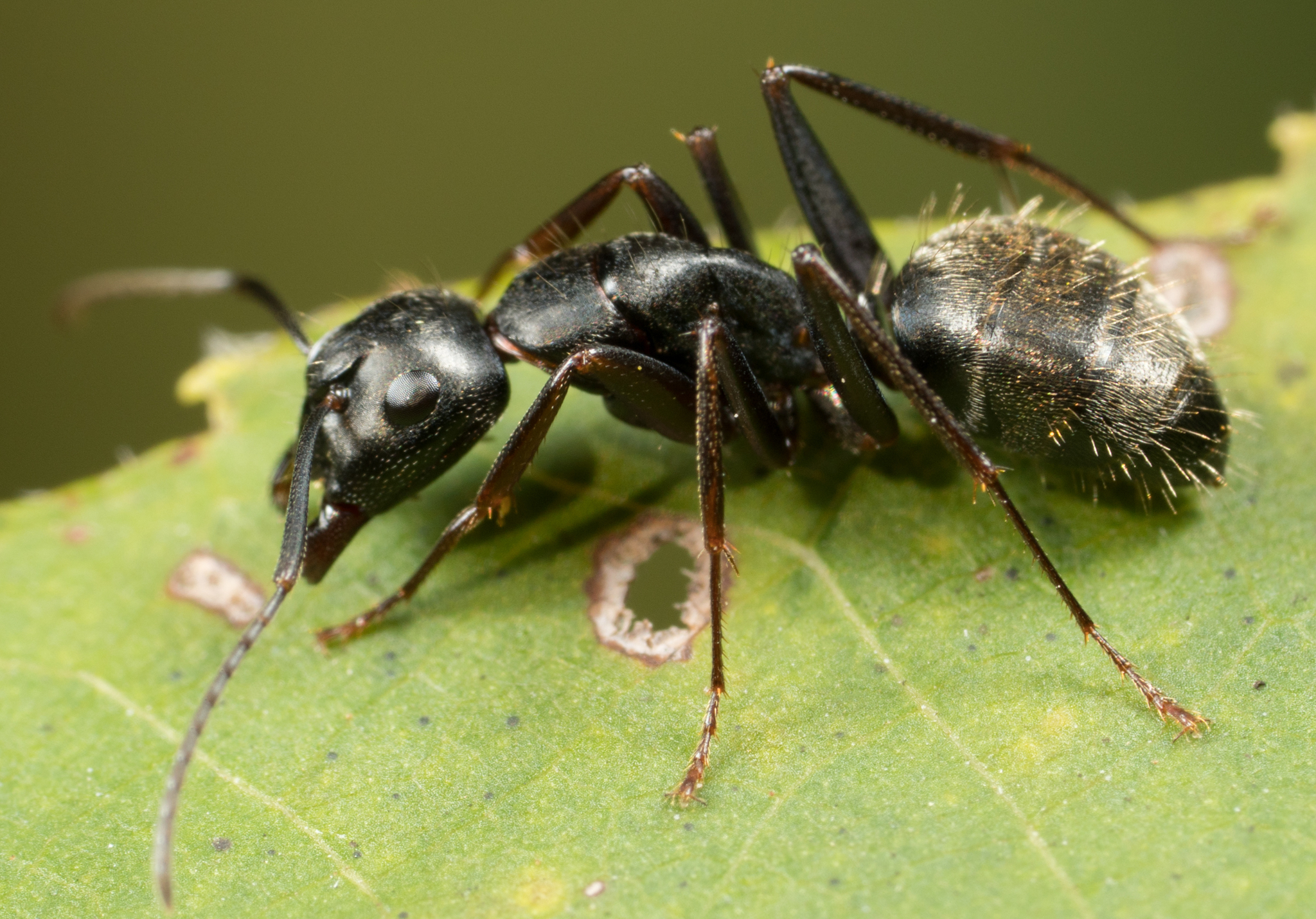
There are 6 or 7 species of carpenter ant established in Massachusetts, which can actually look quite different, but about 2/3rds of the carpenter ant population is a single species, the eastern black carpenter ant (Camponotus pennsylvanicus), which is completely black, aside from yellow hairs on the abdomen in rings, which can look like stripes. Workers come in various sizes from 1/8” to 1/2” in length, but are most commonly around 1/4”. This is noticeably larger than any other ant in New England.
Carpenter Ants vs Termites
Unlike termites, carpenter ants do not digest wood. They are not using it as a food source; they are merely chewing it up and spitting it out. They do this so that they can live in the resulting gaps in the wood, which are called ‘galleries’. Carpenter ant galleries are smooth to the touch compared to that of termites, but usually have a ‘kick hole’ somewhere, through which they dump their chewed up sawdust. Termites will leave no such debris since they are consuming it (although they will leave fecal pellets called ‘frass’ inside their galleries). For this reason, if you are seeing a pile of sawdust-like debris somewhere, you are probably not dealing with (just) termites, and you should look above the debris for the kick hole, which may even be in the ceiling.
Since they’re not actually consuming the wood, and the colonies tend to be smaller than those of termites, carpenter ants are typically not as destructive as termites, but they can still be very destructive if left untreated. I personally, when looking for a home, have had to walk away from homes with significant carpenter ant damage, which was probably the result of years or decades of neglect. Carpenter ants prefer rotted wood since it is softer and easier to chew, so they often coincide with moisture damage, but they will make use of undamaged wood too.
Winged ants are very commonly confused with winged termites - understandably so. Both represent the reproductive caste (also known as swarmers or ‘alates’) of their respective species - worker and soldier castes of ants and termites do not have wings. Although they are superficially similar, if you take a close look, they are quite easy to differentiate. I have made a quick reference here: 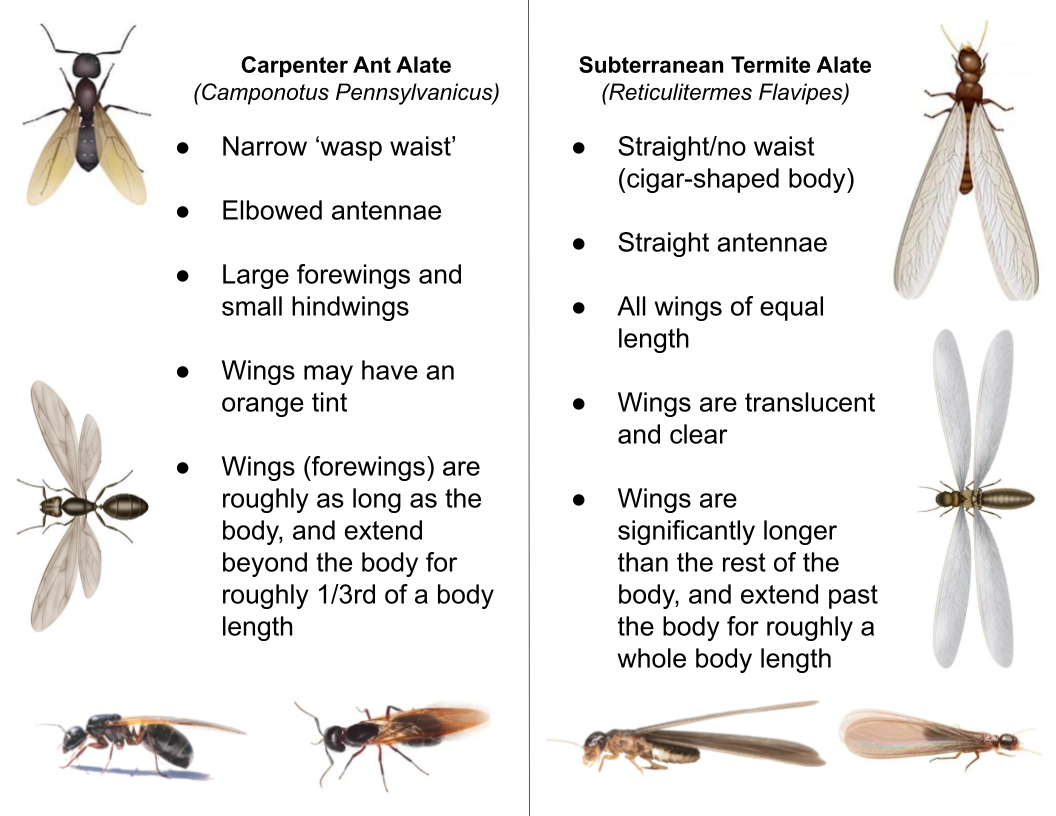
There are some other contextual clues that we can use too. I find that customers with termite swarmers often leave the house in the morning, and come back at lunch or the end of the day and suddenly find hundreds of dead swarmers somewhere in the house. This is because termites need a lot of moisture to survive - they are adapted to living in the ground after all - and will therefore dessicate very quickly inside most homes. They also shed their wings rather quickly, so you may find a few swarmers without wings crawling around, probably near a window, and a lot of shed wings nearby. Carpenter ant swarmers tend to be more resilient, but less numerous, and are sometimes accompanied by non-swarmers. Bear in mind that if you have found termite swarmers, that colony has likely been there for a few years already, and you should definitely get the house treated to minimize further damage.
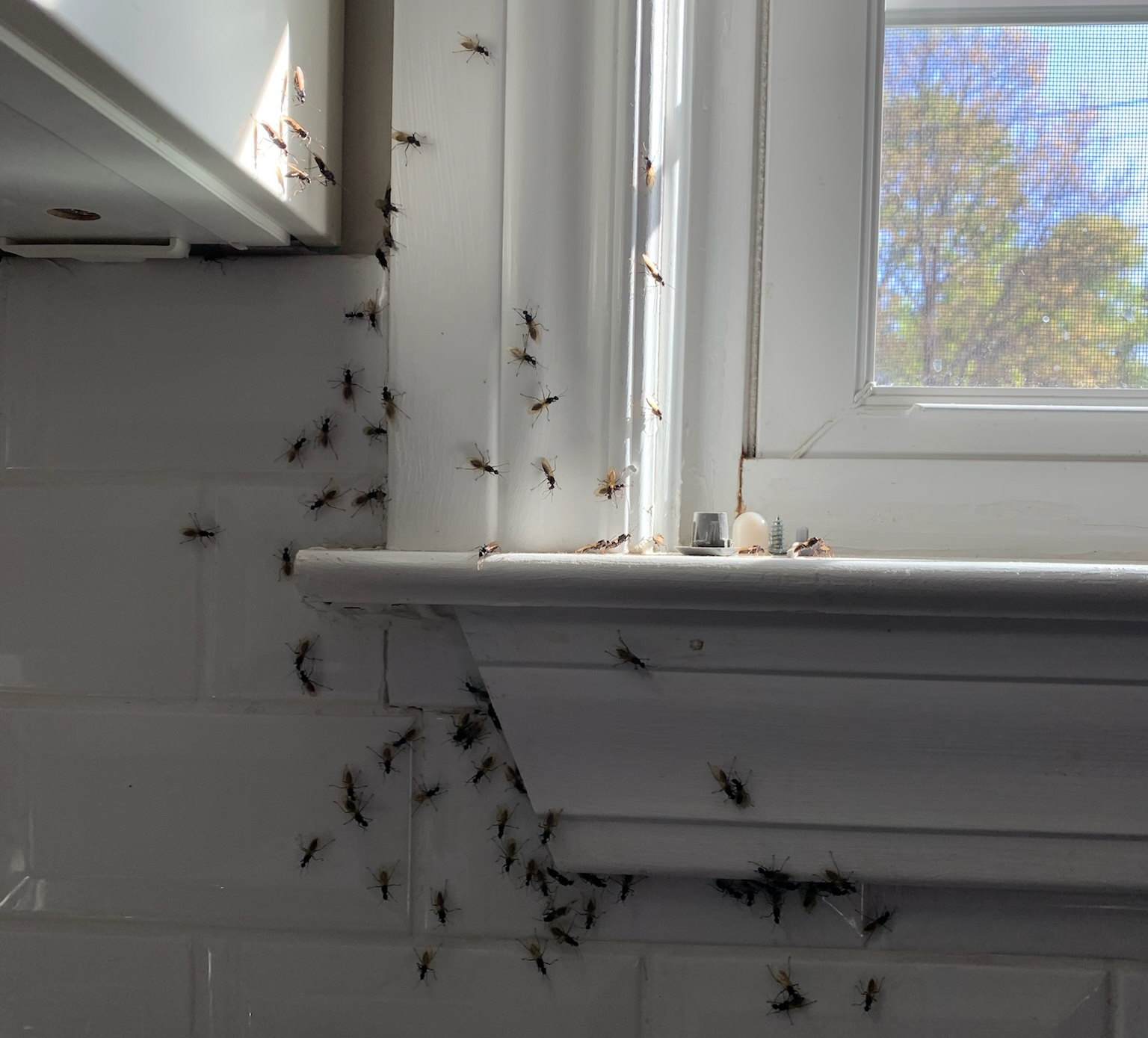
See below for an example of carpenter ant swarmers found at a customer’s house near a window sill (a typical location). Note that since the antennae are rather thin and tapered, it is difficult to see that they are elbowed. If you look closely, in the upper left near the cabinet corner there is a non-swarmer:
Carpenter Ant Nests
Mature carpenter ant colonies usually end up with a population in the high thousands to low tens-of-thousands. However, they have an interesting survival strategy of building ‘satellite nests’ in addition to their main nest. These satellite nests do not host a queen or any eggs, which allows them to be built in more diverse locations. When we find a nest in a house, it is usually one of these satellite nests. This is why we also need to treat the exterior of a house - we use a special insecticide that the ants will carry with them to the main nest, which is usually in a tree stump or dead limb, to completely eliminate the colony. Most commonly, we find satellite nests just below the siding and/or around windows. It has been hypothesized that they are more often found on the south side of a house due to the warmth of the sun, which seems plausible, but I have not seen any hard evidence to back this up.
Like other ants, carpenter ants can get very disrupted by heavy rain. Sometimes their nests or feeding sites can get completely flooded, forcing them to find alternate shelter or food quickly, and this can lead to them entering homes.
Carpenter Ant Behavior
Carpenter ants do not have a stinger. They may bite in self-defense and are capable of spraying formic acid (into the wound), but are very unlikely to do so unless you are seen as a threat to the nest.
They forage up to 300 feet from their nest, which is much farther than pavement ants do. This has two very important implications. Firstly, unlike many other pests, restricting their access to any food in your home is not guaranteed to prevent infestation, since they probably have other food sources outside the home. This explains why many people with carpenter ants actually have quite a clean home, although if they’re in the kitchen or forming a trail inside the house, they probably have access to some kind of food source inside. Secondly, in my experience many homeowners do not discover a carpenter ant nest (and the associated damage) until they happen to remove the siding, and I think this is in part because those ants are not getting a meaningful amount of food from inside the house - these homeowners typically report seeing no ants at all inside, or perhaps just the occasional one.
Bear in mind that if you don’t know what you’re doing, trying to treat an ant nest yourself may make things worse, as applying certain insecticides will cause the ants to disperse chaotically around the home. You may kill a lot of them, but if you have not eliminated the main nest and any satellite nests, the problem is unlikely to be resolved and you may just be facing the same issue a week later. It can also make it harder for a professional to then come in and treat it, since the ants are no longer acting normally.
References & Further Reading
- iNaturalist
- NPMA Field Guide
- Mallis Handbook of Pest Control
- AntWiki
About the Author
My name is George Clark and I have been working at Ransford since 2021. I am a licensed pest control technician in Massachusetts and also hold a category 41 certification. I hope to become an associate-certified entomologist (ACE) once I become eligible. I think the most interesting pests are roaches, termites, ants and social wasps, because they all have some very interesting survival strategies that have made them unbelievably successful.