

By George Clark
Certified Structural Pest Exterminator
We all instinctively find the idea of rodents running amok in our homes unpleasant, but they cause harm in ways that aren’t immediately obvious. Mice are constantly discharging micro-droplets of urine throughout the day (and night), and will also mark safe passages and foods with urine and droppings. This waste dries and becomes particulates in the air of an infested home; multiple studies have shown links between the levels of rodent allergens in a home and development of asthma, particularly in children.
Another concern is physical damage that mice can cause to your property. As a matter of fact, a lot of our customers first came to us as a result of rodent-destroyed appliances - ovens, fridges, dishwashers, hot tubs - as well as vehicles. Part of the reason for this is that some wires use a soy-based coating, which to a mouse is nothing more than a convenient source of protein.
This leads us to what is going to be a recurring theme here: we need to try to think like a mouse if we can. We need to try to see food sources, methods of entry, and safe hiding spots as they do.
How are mice getting into my home?
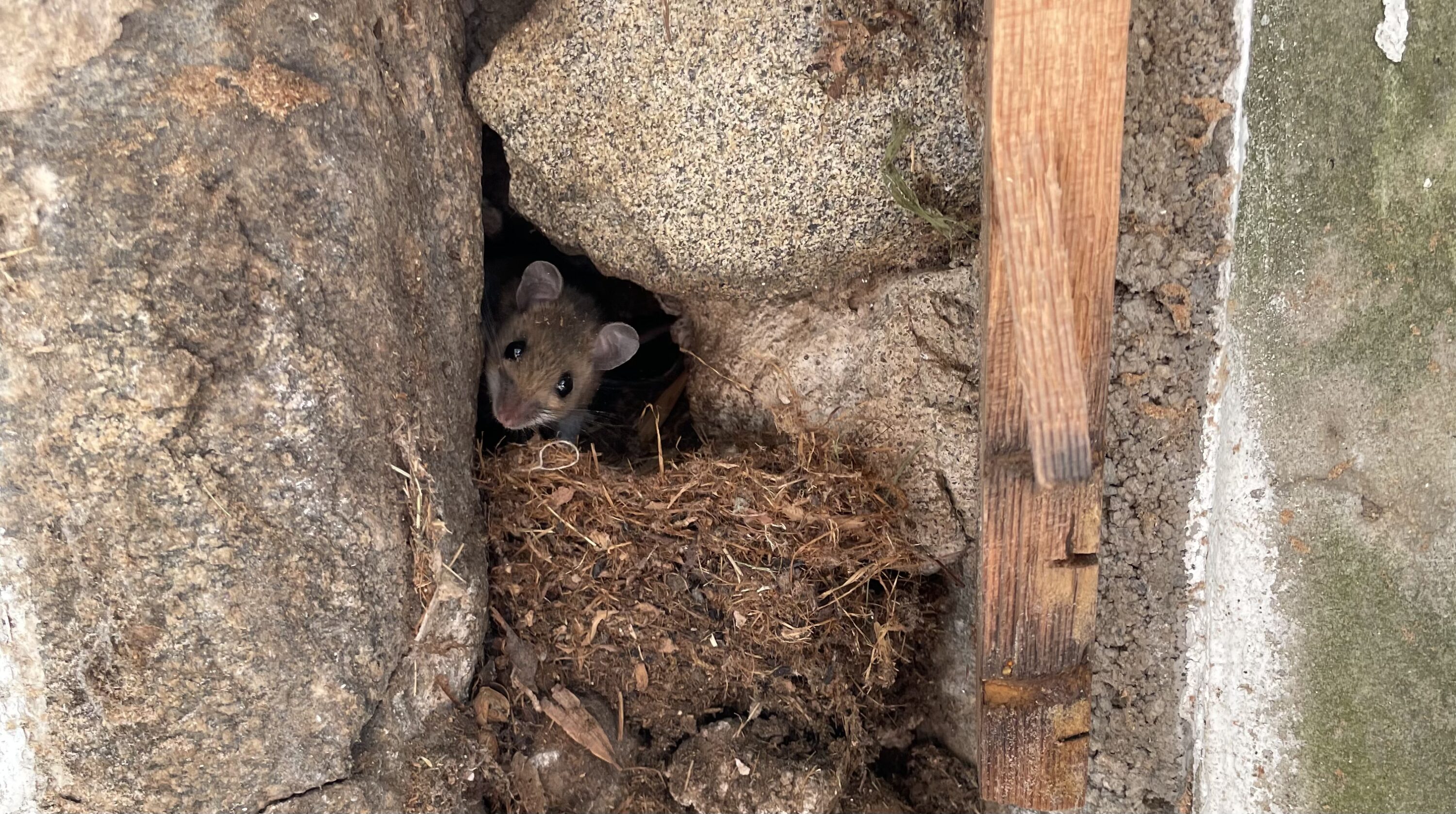
First of all let’s get a harsh reality out of the way: if the foundation of the home is in bad shape (particularly if it’s fieldstone), you’re going to be fighting a losing battle here. An adult mouse can squeeze through a gap or hole about half an inch wide, roughly the width of a human pinky finger or slightly smaller than a dime. Much like the house itself, a good rodent prevention strategy is going to be based on the foundation. The ideal solution is to have the foundation encased in hydraulic cement if it isn’t already. If the foundation is mostly fine, but there are still some gaps, it may be worth getting it repointed.
The other major vulnerability in most homes is the siding. Often we find sizable gaps at the bottom of the siding, where it meets the foundation; or at the corners. Do you hear noises in your attic, but never seem to see or hear signs of mice anywhere else in the house? This may be because they’re getting in at the corners of the siding and climbing straight up to the attic, which seems to be a surprisingly common scenario. There are products available to seal both the bottoms and corners of siding, but they need to be custom fit, or else they may be completely ineffective. Don’t see any gaps? Make sure you’re getting down to a mouse level - you will need to get on your hands and knees and use a mirror to be able to properly see if there are gaps at the corners of the siding.
One clue as to which holes the mice are using is the presence of ‘rub marks’. These are black stains caused by the natural oils (sebum) that the mice secrete. If a hole is being used a lot, these marks will often form. We also commonly see them in kitchens, usually around baseboard height.
But why are mice up against the side of the home in the first place? Again, think like a mouse. Their main predators are birds, particularly owls. This means they don’t want to be caught in the open, and will spend as little time in open areas as possible, so it really helps if you don’t have plants and other cover up against or near the foundation of the home. Even when it is theoretically possible for mice to get in, it helps to at least not make it easy for them.
What are mice after when they enter my home?
Entry points aside, what draws mice to the home in the first place? Many people will just say food and warmth (shelter) and leave it at that, but what does that actually mean? I’m not going to tell you to not heat your home, so if we’re interested in preventing a mouse infestation, we can set that aside. This leaves us with food.
I have often found it difficult to explain to customers that what ‘food’ means in this context is not necessarily what we humans think of as food. Yes, it may mean your leftover pizza that has been sitting in a box on the counter, or the remnants clinging to the dirty dishes, but even a superficially ‘immaculate’ home is often itself home to many food sources for the discerning rodent. Just to name a few of the worst offenders:
- Pet food - many people free feed their dogs for example, but are unaware that this kibble can be unintentionally feeding entire families.
- Garbage - many people think that so long as food waste is put in a trash bin, it’s out of the equation. This is not so, as they’re often stored in bins with no lid, allowing the mice to dive right in and climb back out when they’ve had their fill. This is particularly a problem with bins under sinks or in other cabinets, since those often have holes somewhere in them. If there is a hole into the wall, this basically means that the mice can travel from their harborage area (typically in the attic or between the first floor and basement) straight to their food source without ever having to even enter the living space of the home at all. In such a scenario, your house cats are set up to fail.
- Food debris - when was the last time you got down on the floor and looked underneath the sofa? Or at the bottom of the freezer? Or the back of the cabinets? Or down that gap between the oven and the cabinets? Come to think of it, basically along any side or surface of the oven? Several times I have shown customers mouse droppings in those little drawers at the bottom of their oven, often all over the cookie sheets that they were storing there.
- Bird feeders - it is truly staggering, the amount of bird feeders on the market today that claim to be ‘rodent proof’ and somehow get away with it. Have you ever actually watched a bird eat from one of these? They don’t have the best table manners. Even if a rodent themselves cannot reach the food inside the feeder, the birds will bring it to them. To a mouse, the loose scattering of bird seed outside your home is like an advertisement: ‘there is food to be found in this area! Have a taste!’. As such, even if the amount of seed scattered from the feeder is small, it is going to attract rodents, which in turn are more likely to smell something inside the house and then find an entry point.
- Bird feeders (again) - the other major problem is food storage. Many a home has been terrorized by rodents as the result of an old, possibly forgotten bag of bird seed in the garage or basement. Any kind of food that is stored in just a bag isn’t really stored at all! Put it in a sealed container of some kind, preferably steel but at least thick plastic. This goes for your bags of rice and pasta in the cabinets too.
Should I call the professionals to handle mice in my home?
Professional pest control can be very helpful both in the short- and long-term. There are essentially 3 things that professionals can do for you:
- Eliminate the current infestation - it’s usually possible to clear out all the mice currently in the house, which is great in the short-term, but unfortunately in Massachusetts we have mice living outdoors. This poses a particular problem if you live either in a heavily wooded area, or close to other (infested) properties.
- Implement long-term controls - this can be through physically preventing entry - ‘exclusion’ - or through use of regularly maintained bait stations to either eliminate the mouse population or keep it very low.
- Provide advice for long-term ‘cultural’ controls - the best thing for long-term control is to restrict access to food. I have already outlined some common food sources for mice, but each home is different, and a professional, who has been properly trained to see the world as a mouse does, can help identify the areas of the home that need attention.