

Need for Rat Services
Over the last few years, we have seen a drastic increase in demand for rat services across central Massachusetts, far more so than with any other pest. Why this is the case is hard to be certain of, but is probably a combination of multiple factors.
I want to get a couple fundamental things out of the way before discussing more specific topics. Firstly, whenever I refer to rats in this article, I am referring solely to the brown rat, also known as the Norway rat (Rattus norvegicus). This is the only species of rat that is established in New England. Despite reports of black rats (AKA roof rats, Rattus rattus) arriving on ships, there has never been a confirmed sighting of a black rat anywhere in New England on iNaturalist. Historically black rats have been known to spread via ships, which is part of the reason they are often worked into theories regarding the spread of the Black Death, but they seem to be incapable of withstanding the climate of New England.
Secondly, they differ from almost every pest we cover in terms of shelter. With other pests, we often talk about ‘harborage areas’, these being safe places for the pest to store food and procreate, hide from predators (and technicians), with a comfortable temperature and humidity for that species. Brown rats, on the other hand, will dig burrows in the soil, which essentially extends their safe harborage area to all land on the planet. Every pest needs shelter, food, and water, and most pests can be controlled simply by removing one of these 3 things, but as far as rats are concerned, we only have food and water to work with. Having said that, there are still things that you can do to reduce the chance of rats creating burrows on your property specifically, which I will explain later in this article.
Rats vs Mice
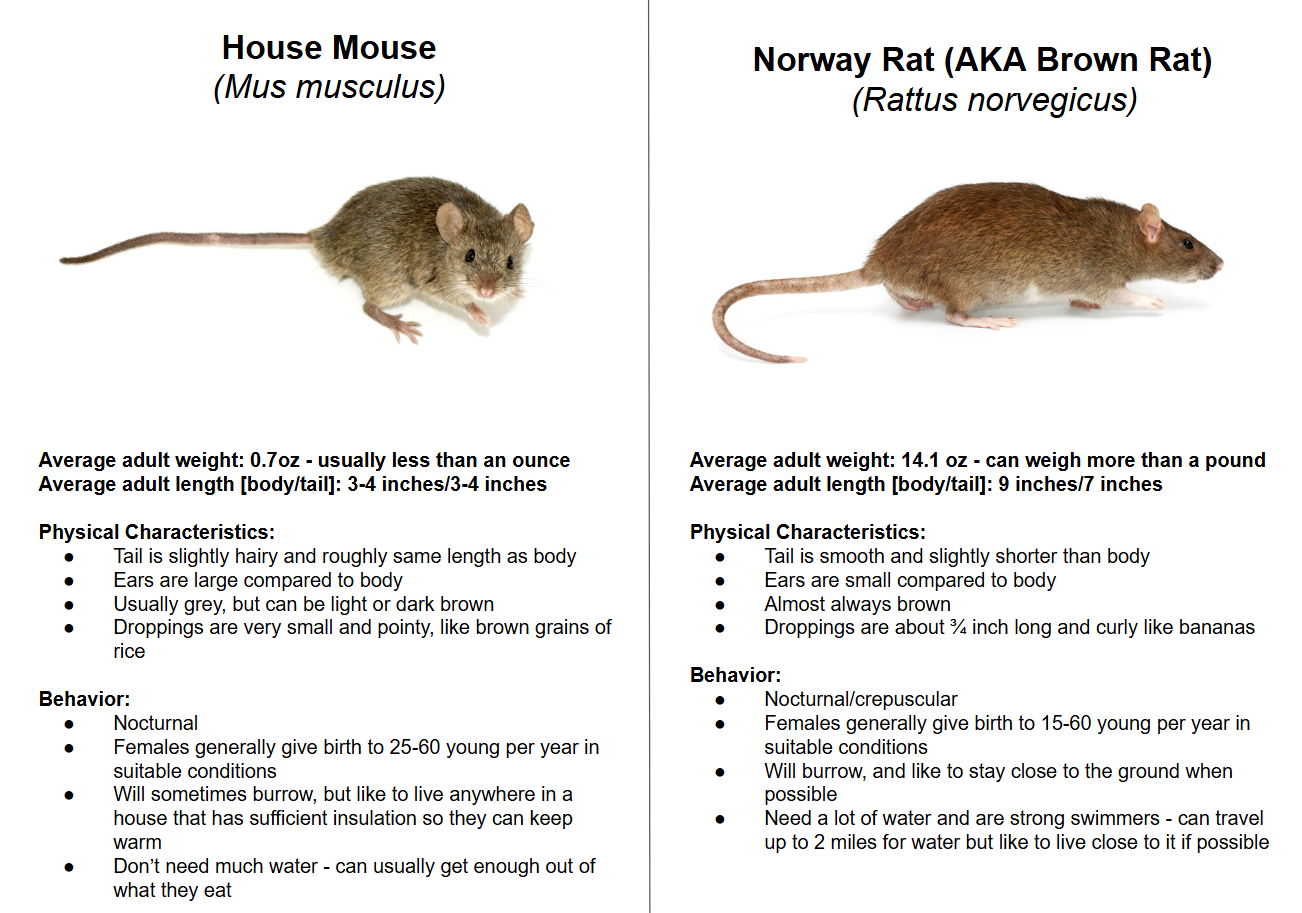
The most common misconception about rats is that they are just bigger versions of mice. While they do share some similarities, they are actually surprisingly different. I think that people also underestimate just how much bigger rats are - the average weights of adult mice and rats are roughly 0.7 oz vs 14 oz respectively. Myths about rats growing ‘as big as cats’ are not true - the biggest recorded brown rat was 1.8 lbs - but that still means a 20x difference between mice and rats. Rats therefore obviously need much more food than mice, but what is less obvious is that they will travel much further distances to get it. Deer/field mice will travel a bit further than house mice, but even they cannot compare to brown rats. I have created a guide below to aid with identification:
Another major difference is that, whereas mice can often get all their water from what they eat, rats need a separate water source. Naturally, water fountains, bird baths, and other garden water features can draw rats to your property.
Unlike their roof rat cousins, and despite the fact that they are quite proficient at climbing, brown rats are reluctant to climb - we rarely see them above the first floor. This is probably due to them wanting to stay close to their burrows. Mice are afraid of rats, and will generally stay high in a building if rats are present in the lower levels.
How to discourage rats from living in your yard
One of the fundamental problems with rats is that they are really a communal problem, owing to their huge foraging range, yet we have no way of eradicating them at a communal level. In a suburban setting, rats living on one property are likely to be foraging for food and water on all surrounding properties. Furthermore, if rats are eliminated from one property, but remain on another property nearby, those surviving rats may repopulate the former cleared property. Lingering rat pheromones can even draw surviving rats to investigate cleared burrows. On the other hand, rats are not stupid, and understand that dead rats in burrows means danger, and may avoid the area because of it.
Burrows are the classic sign that rats are living on a property, but they are not the only animals that create them. If burrows appear, they should be watched closely to see what is inhabiting them - trail cams are the perfect tool for this job. Rats are naturally crepuscular, meaning they are most active around dawn and dusk, and I commonly hear from customers that they have spotted rats in the evening.
It is extremely important to not provide food and water sources for rats, since we cannot remove their opportunity for shelter. One of the biggest draws for rats are bird feeders (and other wildlife feeders) - even ones that claim to be ‘rat-proof’. I have had reports from customers of rats climbing these ‘rat-proof’ feeders, and even if they don’t, birds tend to spill the food all over the ground, making it accessible to the rats. Even if the amount that is spilled on the ground is not enough to sustain a large population of rats by itself, it will still attract them to the property and make it likely that they will dig burrows and start living there.
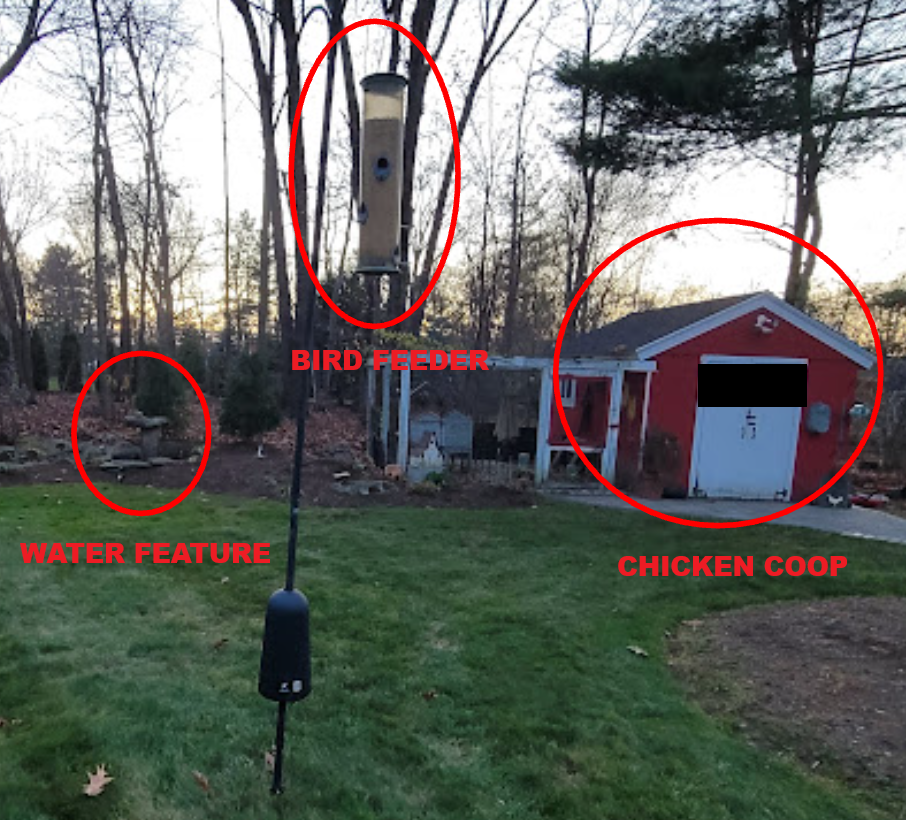
Similarly, chicken coops are often a problem in attracting and feeding rats. Most chicken owners I have spoken to do not secure the chicken feed properly, and most coops have a dirt floor or at best flimsy floorboards which means the rats can tunnel into the coop with ease (they also often tunnel under and into sheds in the same fashion). Any feed should be stored in secure metal containers when not actively in use, and the coop should be regularly cleaned of debris. This means both feed and feces, which leads me to my next point.
Rats are coprophagic, meaning they will happily eat feces, including their own as well as that of other species. Many dog owners do not pick up their dog’s feces, which is not only an attractant, but a significant food source since there can be a lot of undigested nutrients in feces.
Although not as crucial, it is worth mentioning that bushes/shrubs provide cover for rats from birds (their main predators), so they will be more likely to dig burrows under shrubbery. This does not mean that all bushes are categorically forbidden, but you should bear in mind that bushes close to your house will encourage rats to get close to the house. This in turn makes them more likely to find any entry points into the home. As an aside, if foliage is touching the foundation it presents an opportunity for insects to bypass regular liquid treatments, which is why we standardly recommend trimming back any foliage so that it is not in contact with the foundation.
How to get rid of rats
First I want to point out that even if a professional is hired to eliminate rats from the property, the measures outlined in the previous section should still be implemented. We can eliminate rats from almost any property, but how long they remain gone depends on how attractive the property is to them, which is largely down to the availability of food and water.
When it comes to the means of elimination, we largely have 3 tools available, which are best used in conjunction with each other rather than standalone means. I will explain each below in no particular order.
First are mechanical traps. These tend to be more useful for rats than for mice, if only because rat populations tend to be smaller (think about how many more mice than rats can be sustained from a given food source given the 20x difference in body weight!). However, they’re still supplemental and can’t really be placed in burrows, which are the main sites we want to target. Instead, we use them mainly to protect structures, either by placing them in our standard exterior bait stations, inside ‘tunnel stations’ (see image below), which do not contain rodenticide but are basically housing for traps that can be placed normally along sills or mounted to walls or beams.
Secondly are rodenticides, which are what we mean when we say ‘bait’. These are quite versatile, as we can place them in bait stations in and around structures, but also use specific ‘meal’ or pellet baits inside the burrows themselves. Doing this means the rats are immediately made aware of the bait and do not have to discover it as they do with bait stations, and the bait is always somewhere that they consider safe, so they are much more likely to eat it. Note that baits take a few days to take effect. Furthermore, if the burrow holes are not deep enough and there are dogs on the property, we may not be able to bait the burrows directly as dogs may be able to access it (although we can still place bait in dog-resistant stations).
Thirdly are gases (we use CO and CO2). This is not fumigation - we only use these in the burrows themselves, never for structures. Whether this is an option depends on where the burrows are - if they are too close to an inhabited structure we may not be able to safely use gas. Gases have the major advantage of working immediately and without using any rodenticide. Furthermore, we can sometimes use a smoke mixture to make secondary burrow entrances visible, decreasing the chance of missing something - rat burrows actually tend to have multiple ‘escape’ holes in addition to the main entrance, but they are less obvious from a purely visual inspection, but if smoke is pumped into the main entrance hole we will see it come out of any connected holes. In most settings we prefer to use bait in addition to the gas, since the gas only eliminates rats that are actively in the burrows when it is applied. However, gas applied without bait can be a great option for stables, barns and similar structures, provided the animals can be removed from the structure during the treatment and or a short time after.
How to prevent rats from entering the home
We’ve talked a lot about preventing and discouraging rats from living on the property, but preventing them from entering a structure is a different matter. We can largely split this into 2 related topics: exclusion and food control.
‘Exclusion’ in the pest control world is a term referring to physically preventing a pest from entering a structure. As a concept this is simple but the implementation can be quite complex and the entry points more varied than most people know. For example, we all know that the vast majority of houses in New England are constructed with clapboard siding. What you probably didn’t know is that where the clapboards connect at the corners of the house, an artificial void is created that runs the entire height of the siding. Mice commonly use this void to climb straight up to the attic, bypassing the rest of the house (though it is probably more common for them to enter the basement first and climb pipes in the walls to reach the attic). We can block these corners with a custom made product that is cut to fit the gap.
Another common type of entry point is a long gap between the foundation and siding, meaning they are not flush. We can block this by installing a long strip of steel. Similarly, many doors have gaps underneath which we can sometimes block using a doorsweep designed for rats - it contains steel wire to prevent rodents from chewing through it.
Some access points are beyond what we can remedy ourselves. For example, if the basement has only a dirt floor or a fieldstone foundation, this is something you would need a different kind of contractor for. A fieldstone foundation should ideally be encased in concrete, since there are far too many holes to manually block and monitor.
About the Author
My name is George Clark and I have been working at Ransford since 2021. I am a licensed pest control technician in Massachusetts and also hold a category 41 certification. I am studying to become an associate-certified entomologist (ACE) after recently becoming eligible. I think the most interesting pests are roaches, termites, ants and social wasps, because they all have some very interesting survival strategies that have made them unbelievably successful.