
Bees vs wasps vs hornets vs yellowjackets
I find that many customers are confused about terminology when it comes to these pests. In particular, many tell me that they have ‘bees’, but in 99% of these cases it actually turns out to be wasps. All hornets and yellowjackets are types of wasp, so in reality, the only two groups we are talking about are bees and wasps. Unfortunately, there is no good, widely-accepted collective term for bees and wasps that excludes all other animals. Many people use the term ‘stinging insects’, myself included, but this isn’t ideal as it could include ants, scorpions, caterpillars, and many insects that either bite (such as certain flies) or cause rashes via their spines (such as carpet beetle larvae), which can be easily confused for stings.
Here is a nested list showing where the relevant types of stinging insect (in New England) fall into groups. This isn’t every single distinction that is possible to make, and none of these are down to the species level, but these are the highest levels where distinguishing between insects is useful for pest control. For example, we could drill down aerial yellowjackets into several species, but that level of granularity is no longer useful in a pest control context:
- Bees
- Social bees
- Honey bees
- Bumble bees
- Solitary bees
- Carpenter bees
- Other solitary bees
- Social bees
- Wasps
- Social wasps
- Hornets
- European hornets
- Yellowjackets
- Aerial yellowjackets
- White-faced hornets
- Ground yellowjackets
- Aerial yellowjackets
- Umbrella wasps AKA ‘paper wasps’
- Hornets
- Solitary wasps
- Cicada killers
- Mud daubers
- Other solitary ground wasps
- Social wasps
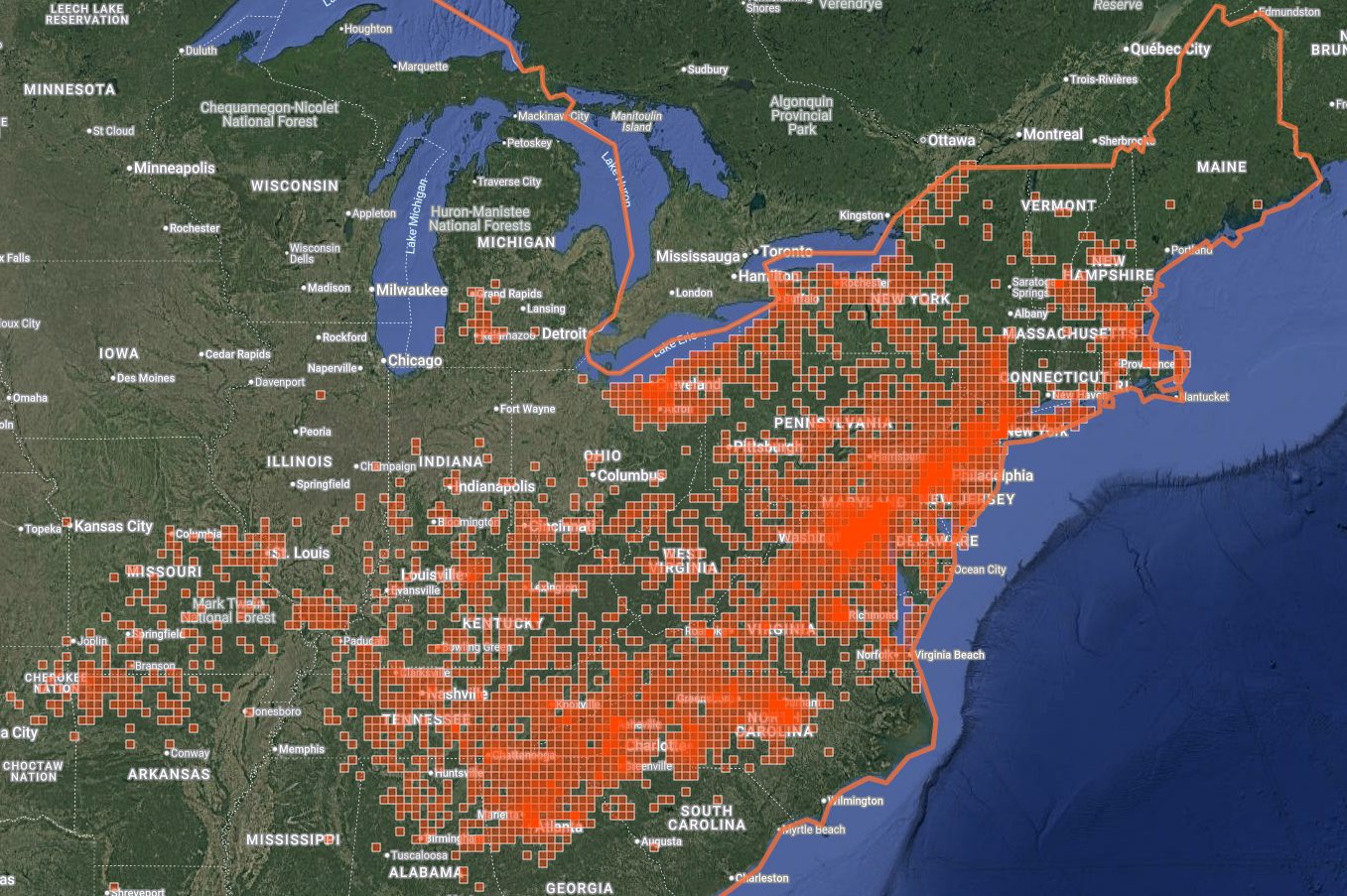
However, while it’s good to be able to distinguish these groups, it’s important to point out that probably more than 90% of stinging insect cases we see are some kind of yellowjacket, whether ground or aerial. Note that this includes ‘white-faced hornets’ (also known as ‘bald-faced hornets’), which are not actually true hornets. The only true hornets in New England, indeed anywhere in North America at all, are European hornets (Vespa crabro). These are quite rare in New England compared to other regions, as can be seen on this map of iNaturalist observations of European hornets:
The simplest and most important distinction is: ‘is it hairy?’. Bees have a lot of hairs - so that they can pick up pollen, one of their primary food sources - whereas wasps appear relatively hairless. Furthermore, only wasps make nests out of paper, so if you are seeing a nest hanging from a tree, bush or soffit, those aren’t bees. Bees will sometimes nest in old rodent burrows, dead trees, or in the walls of structures. Generally they should be left alone as they are environmentally beneficial and less aggressive than wasps, but if there is a nest in an inconvenient spot or you’re allergic, it makes sense to get the nest treated or removed. The latter is done in certain honey bee cases - you may be able to find a local beekeeper who is interested in moving the honey bees off-site. However, they will not be able to do this if you have sprayed any kind of pesticide.
What does a wasp nest look like?
I think it makes the most sense to divide nests into 5 main categories when it comes to appearance:
- Aerial nests (yellowjacket)
- Aerial nests (umbrella wasp)
- Ground nests
- Void nests
- Mud dauber nests
Aerial nests (yellowjacket)
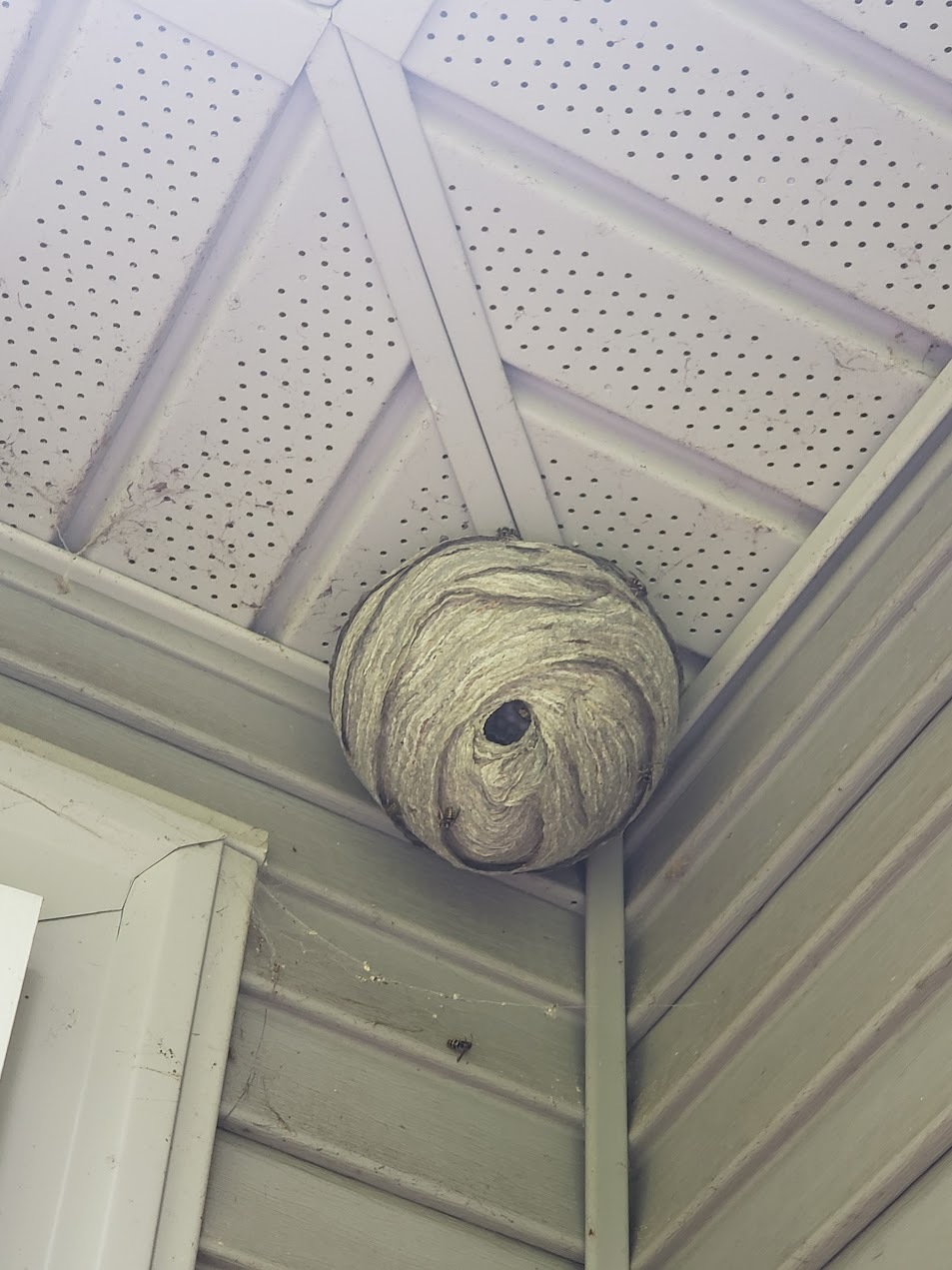 Aerial yellowjacket nests are what you probably picture when you think of a wasp nest. They are typically grey in color, being made from a wood pulp that the wasps chew up and spit back out. They can be found hanging from trees, soffits, decks, or occasionally in bushes. In the early stages of development they may be the size of a golfball, but at full size in the late season (Aug-Oct) they can reach the size of a basketball or larger, but they are more football-shaped than spherical. By the end of the season these nests have several thousand workers.
Aerial nests (umbrella wasp)
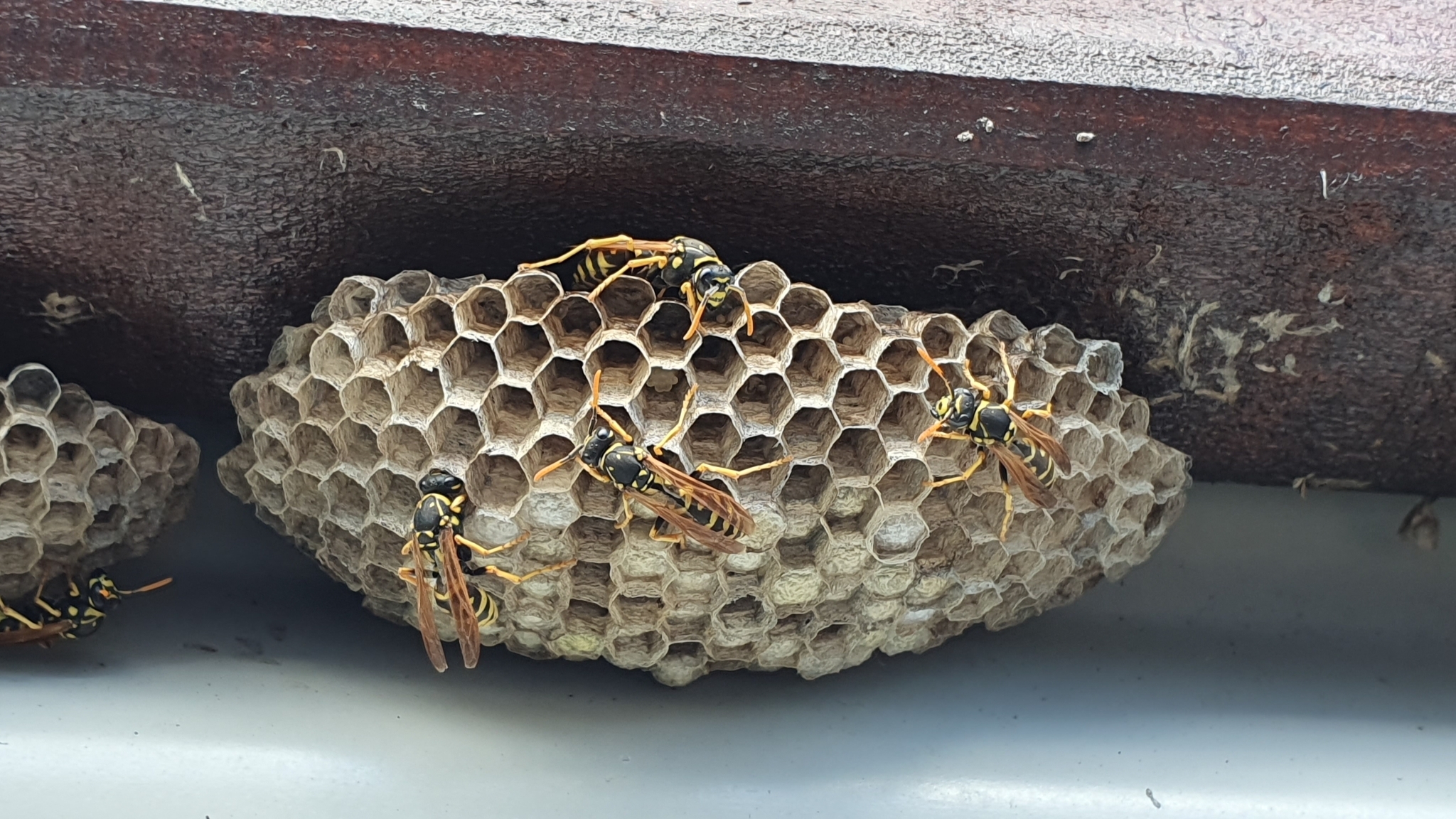 Umbrella wasp nests are less common and look a bit different. Whereas yellowjacket nests have a protective shell, umbrella wasp nests consist solely of a single layer of open cells (hence the name, although most sources still refer to them as ‘paper wasps’, which I think is very confusing since not only are they not the only type of wasp that makes nests of of paper, but they’re not even the type most people think of when they think of a paper wasp nest). Umbrella wasps tend to be more dominant in early spring, possibly because several queens build the nest together - as opposed to yellowjacket nests wherein a single queen founds the colony - but fall behind in the late season, rarely reaching more than 250 workers. They are correspondingly less aggressive.
Ground nests
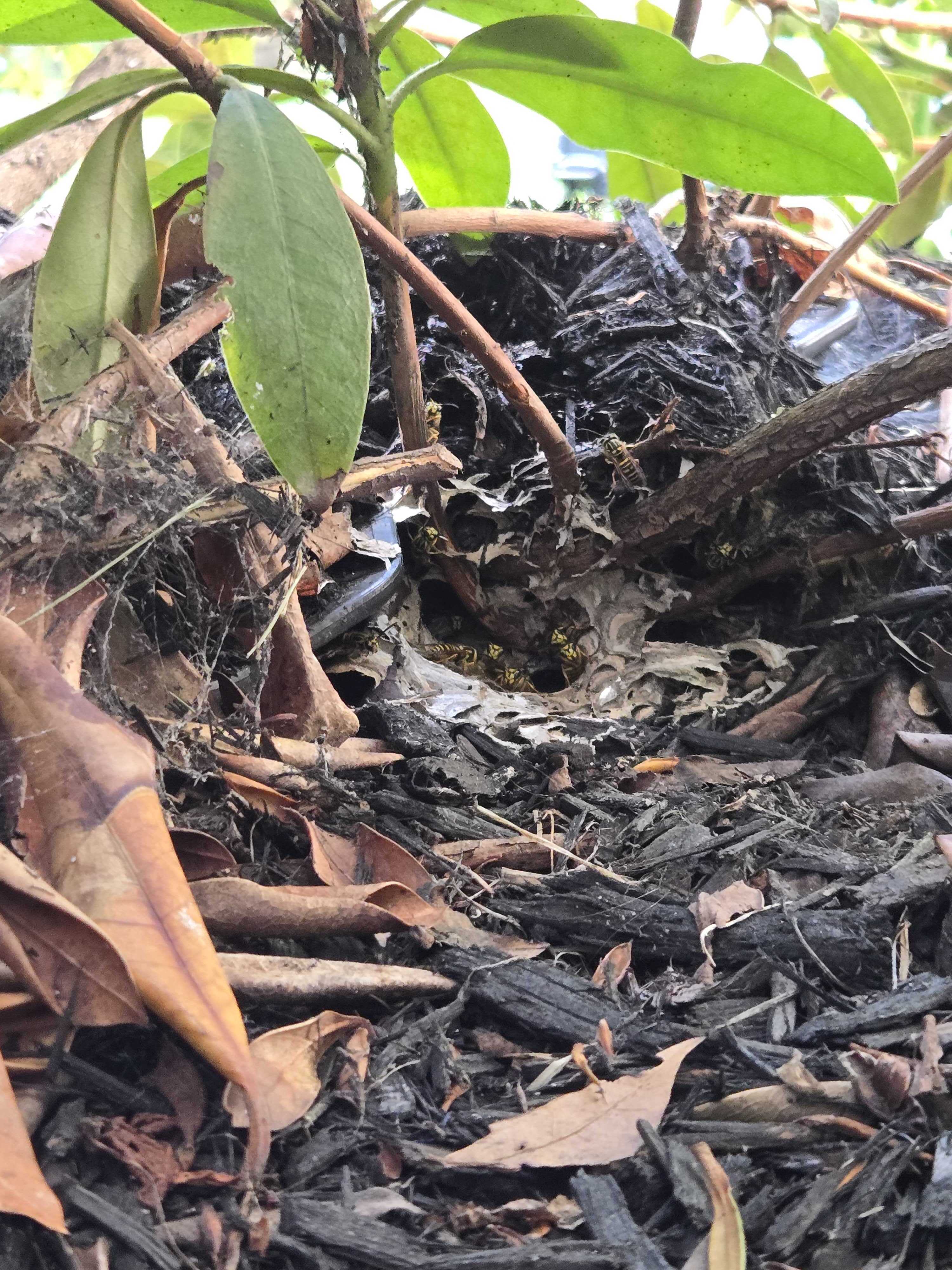 Most ground nests we find are yellowjackets, but other bees and wasps will do this too. They do not dig - they make use of old rodent burrows. It’s important to note that you can also get solitary ground wasps, which do not have a nest but are sometimes confused with ground nests. The treatment for these is completely different. You know it’s a nest and not solitary wasps if you see a single hole that is being used by multiple wasps - solitary ground wasps each have their own individual holes. Solitary ground wasps prefer sandy soil as it has good drainage, so for long-term control / prevention we recommend altering the soil to be less sandy. Since ground nests use old rodent burrows, there are typically multiple entrance holes, and they are often under cover - a lot of the time when someone reports a nest in a bush, it’s actually a ground nest that uses the bush for cover.
Void nests
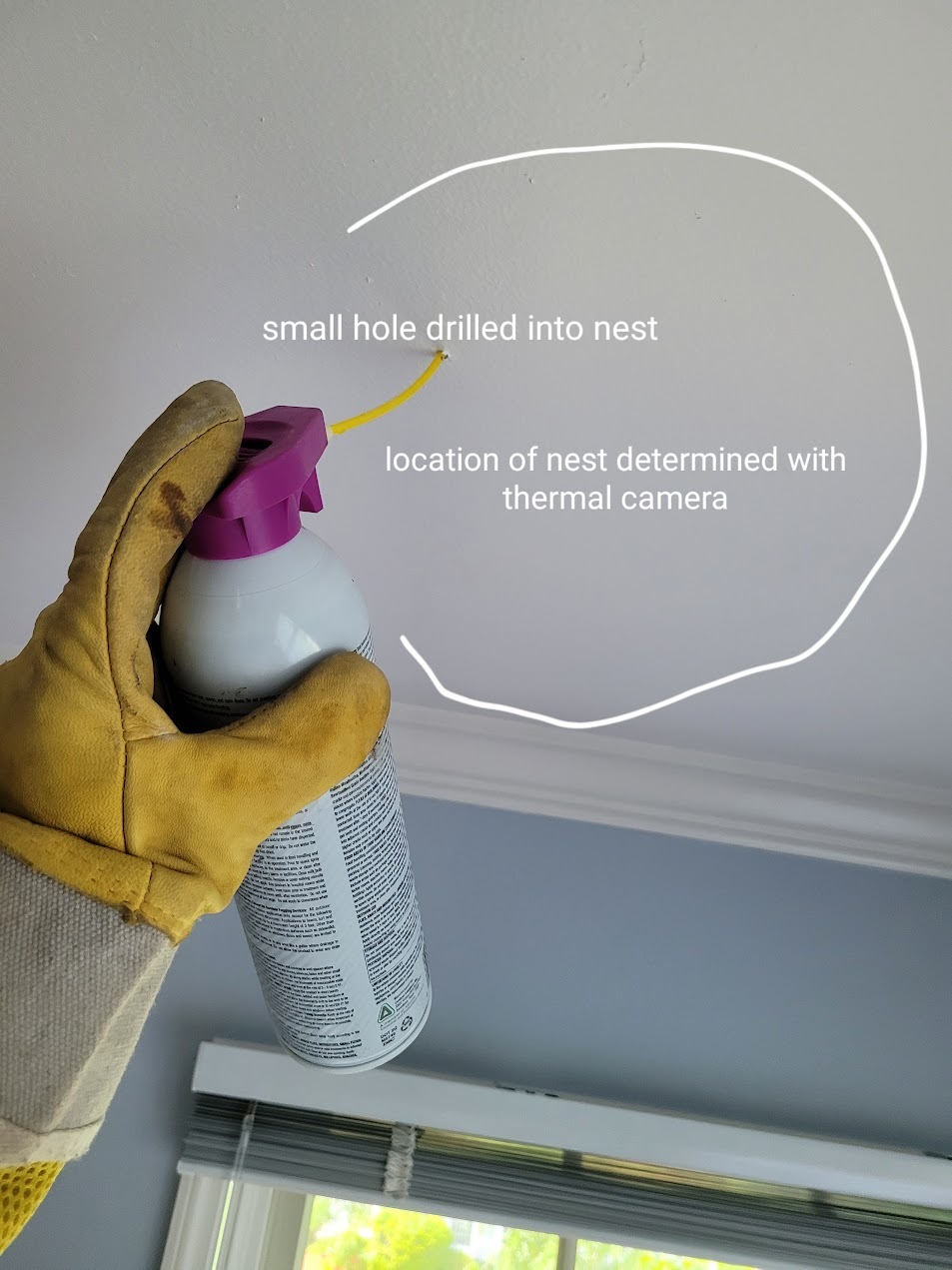 Like ground nests, void nests are typically made by yellowjackets but can be other species of bee or even wasp, since the instincts and ability to create a void nest are essentially the same as with a ground nest (i.e. finding a pre-existing cavity to use as shelter). The difference is that void nests are located in structures e.g. the void in the wall of a house. This is the trickiest type of nest to deal with, and the only type that I recommend never trying to treat yourself - if you spray anything into a void, you are unlikely to actually eliminate the nest, but very likely to push them into new areas and make them harder for a professional to deal with.
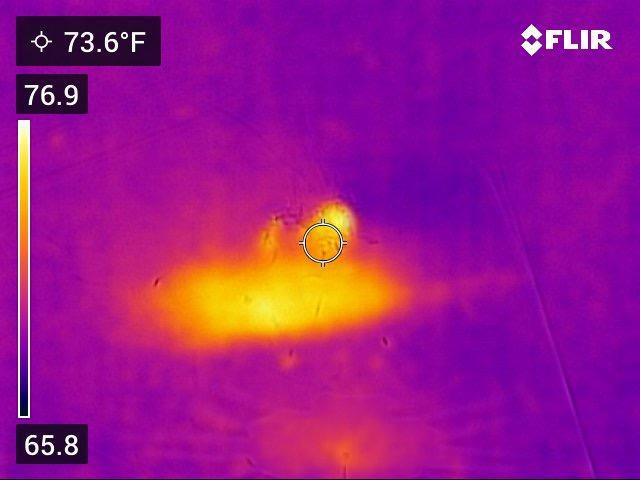
The actual nest itself will probably not be visible, but you may see several wasps flying into a hole in the house. Most commonly this occurs at one of the corners of the structure, and typically where the siding meets either the soffit or foundation, since these locations usually have natural gaps. However, one of the potential complications with void nests is that the nest is sometimes quite far from any treatable holes. In these situations we may have to use a thermal camera to see the nest through a wall or ceiling, and drill a small hole in order to inject the nest with a dust or aerosol. This may be impossible if you have already tried to spray the nest with something.
There is arguably a subtype of void nest which we call a ‘breakthrough nest’, which is basically the worst-case scenario. This happens either when a void nest runs out of space in the void but wants to continue growing, or it becomes trapped because their access holes into the void have been blocked (which is why you should never try to do this). The wasps, seeking either to escape the void in which they have become trapped, or excavate more space to expand the nest, chew through drywall (which is relatively soft) and emerge into a room. They will then typically rush through this hole as they are attracted to the light seeping through. Thankfully, most of the time there is a warning for a few hours or days beforehand: many customers report a kind of ‘rustling’ sound, which is in fact hundreds of wasps moving and chewing on the other side of the wall or ceiling. We try to always prioritize void nest calls in our schedule, partially because of the risk of turning into breakthrough nests. If you suspect you have a void nest, and especially if you can hear a rustling sound, do not touch that part of the wall or ceiling as it may be thin enough that you break through it.
Mud dauber nests
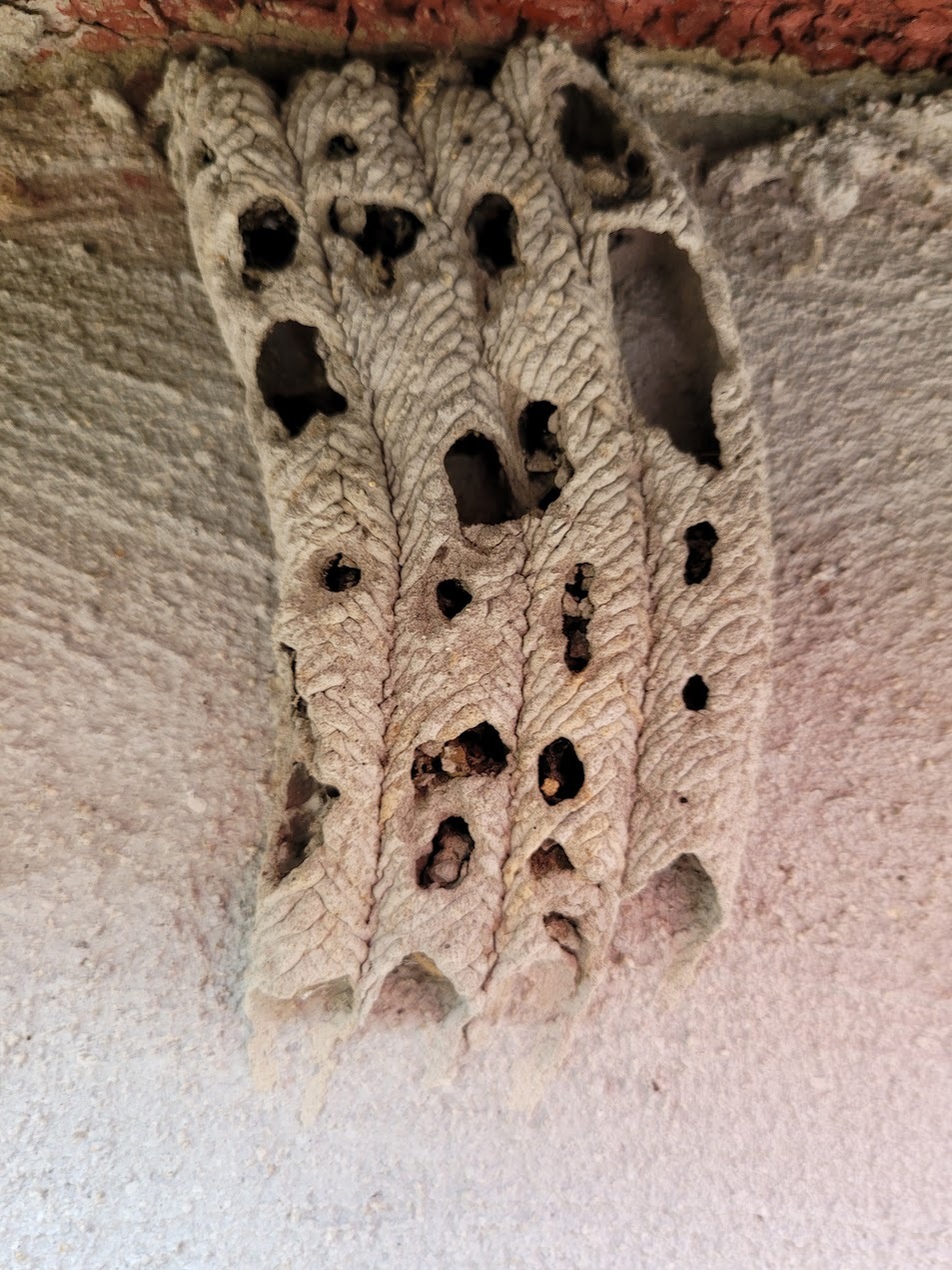 Dialling it down a bit for the last one - mud dauber nests are of the least concern. Mud daubers are a type of solitary wasp, and unlike solitary ground wasps they do not tend to even live near each other, so the chance of encountering more than one at a time is low. They don’t really have a ‘nest’ per se, but what we call a nest is basically a structure they build that they can lay an egg in. They will then hunt, paralyze, and transport spiders to this structure so that they can be fed on by the larva once it hatches. Since they aren’t really around to guard their ‘nests’, you are unlikely to encounter any resistance if you just physically remove them. Sometimes they will build several of these nests next to each other, and they’re typically above eye level.
Frequently asked questions
Here are some other miscellaneous questions I frequently get asked about wasps and bees:
Do wasps come back to the same nest every year?
No, wasps build a new nest each year. For this reason it is important to establish that any nest is currently active before having a professional treat it, since otherwise you may be wasting your money on an unnecessary visit. Nests in early spring are roughly the size of a golfball, growing to football size and beyond, reaching a peak of almost the size of a basketball (although not spherical) around Aug-Oct. Therefore, if you see a huge nest in May, you can be sure that it’s an old nest.
Inactive nests usually deteriorate within a year without workers to maintain them, but I have had customers report them lasting for multiple years in particularly sheltered spots.
Can’t you just physically remove or burn the nest?
Physically removing an active nest is not a good idea except in certain situations. It’s fine in early spring, when nests are just getting started and no workers have hatched yet. Ideally this should be done at night so that any queens are eliminated.
However, later in the year, physically removing a nest presents several problems. You would need to do it at night, when most workers are in the nest, and do it rapidly enough that they cannot exit it. If you don’t do this, and either remove it during the day or allow the workers to exit the nest, there will be thousands of wasps lingering in the area. They will often build a new nest in the exact same spot or nearby, and are likely to be aggressive during this time.
What time of year are wasps most aggressive?
The aggressiveness of a nest basically scales linearly with its size, which grows as the year goes on. Early in the season there is only a singular queen (in yellowjacket nests) or multiple queens (in umbrella wasp nests), and no workers. The queens are very unlikely to be aggressive since they have everything to lose and no workers to protect them. Nests are most aggressive in Aug-Oct (and this is when we get most of our wasp calls), since there is a huge surplus of workers that are essentially dispensable.
Are wasps active at night?
As a general rule, wasps are not active at night. They attempt to return to their nest each night and begin foraging again in the morning. Their level of activity basically correlates with the daily temperature, being most active in the afternoon. This is actually quite an important consideration for us when it comes to void or ground nests, since we want to maximize the chance of a technician finding the nest, and the wasps will be using the entrance holes most frequently in the afternoon.
However, if we think there is a chance we will need to go into the attic, we tend to schedule those jobs first thing in the morning, since it can be dangerously hot for technicians in the afternoon. We also may schedule the job first thing in the morning if we think we will need to use a thermal camera to find the nest in a wall or ceiling, since all the wasps are in the nest generating heat, and the ambient temperature is cooler, making the image more obvious. Contrary to what many people think, we do not need to schedule wasp treatments at night, since we use a residual product. This product sits in the nest and will eliminate the workers that return to the nest overnight, as well as any new larvae that hatch.
Do bees / wasps sting more than once?
All bees and wasps that sting are capable of stinging multiple times. However, honey bees specifically are prone to getting their stinger stuck in thick skin or fabric, in which case it may tear out, killing the worker.
Do fake wasp nests actually work?
I can’t say much as to whether specific fake nests work to reduce the chance of wasps making a real nest nearby without research showing this to be the case, but I think it’s unlikely. I have also heard the claim that old wasp nests help deter new ones - and have repeated this myself - but I actually can’t find any strong evidence supporting this claim. I’m not sure where it originated, but if there has actually been research showing it to be true, I would be interested in seeing it. Anecdotally, it is quite common for us to find new nests near old ones, sometimes so close they are almost touching.
When should you call someone instead of spraying it yourself?
Of all the pests that we cover, stinging insects are the most dangerous. This is true even if you do not have a known allergy to them, as you can develop one over time. When it comes to void nests in particular, I particularly advise against trying to treat them yourself, for all the reasons I laid out in the section on void and breakthrough nests above.
References & Recommended Reading
- NPMA Field Guide for Structural Pests (2nd edition) by Eric H Smith and Richard C Whitman
- Handbook of Pest Control (10th edition) by Arnold Mallis et al
- The Social Wasps of North America by Chris Alice Kratzer
- iNaturalist
About the Author
My name is George Clark and I have been working at Ransford since 2021. I am a licensed pest control technician in Massachusetts and also hold a category 41 certification. I hope to become an associate-certified entomologist (ACE) once I become eligible. I think the most interesting pests are roaches, termites, ants and social wasps, because they all have some very interesting survival strategies that have made them unbelievably successful.