
Welcome to Wasp Wednesday!
Wasp Wednesday is a weekly series, starting in August, that will cover information on wasps found in Massachusetts.
This week I'll be talking about white-faced, or bald-faced, hornets!
What is a Bald-Faced Hornet?
Contrary to their name, bald-faced hornets, also known as white-faced hornets, are not true hornets; they are just a species of yellow jackets that stand out with their white markings. They get their name from the white on their faces that makes them distinct from most other species of yellow jackets.
Bald faced hornets are considered to be one of the most significant structure-infesting wasps. While their nests are often found in trees and shrubs, they won't hesitate to nest on or in structures. Their nests can get absolutely gigantic in summer, going over 2ft (!) in diameter though that is more common in climates with longer seasons than ours in Massachusetts.
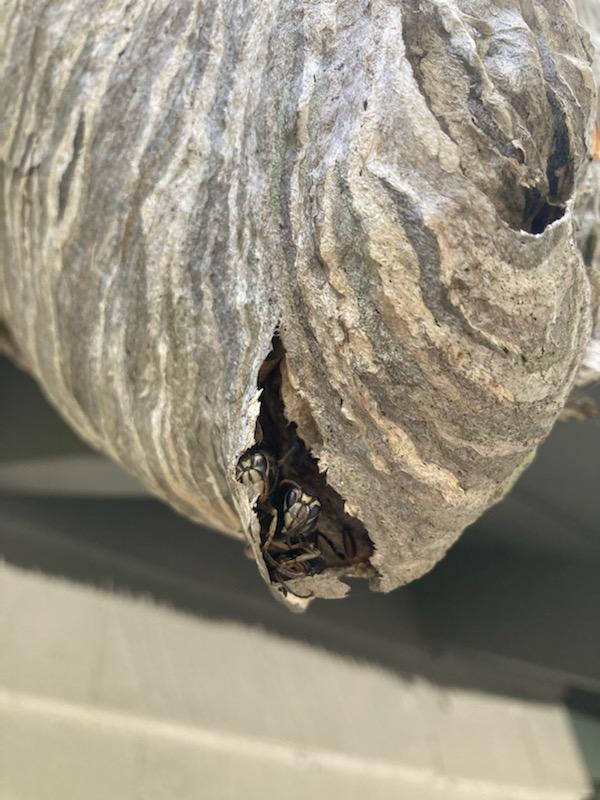
How Dangerous are Bald Faced Hornets?
If you have a large nest, they are nesting in a void of your home, or someone in the home has an allergy to wasps we would recommend professional treatment for bald faced hornets. They can be aggressive further from their nest than you might expect, and their colonies can reach larger numbers than other wasps (like paper wasps). They are still considered beneficial pollinators, and so if they are not near a structure, an area that is frequented by people, or are high enough up out of the way we recommend leaving them alone.
How to Get Rid of Bald Faced Hornets?
With all wasps, care should be taken to ensure your safety prior to attempting to handle the nest. If you are unsure or weary, it may be best left to the professionals - especially with how aggressive bald faced hornets can get when disturbed. You can call us at 508-756-5197 or by submitting the contact form at the link above to get help with wasps any time of year. We prioritize dispatch for wasp calls, especially if someone in the household has an allergy!
When making your risk assessment on attempting to remove your own bald faced hornets nest or ask a professional, it is important to consider colony size and if you can see the nest. Larger colonies are more aggressive around a larger distance from the nest. When you can't see a nest, but you can see them going in and out of your home or other structure, it is considered them nesting in a 'void'. Void nests require particular care with treatment to ensure that you are actually reaching the nest and not just interfering with their current entrance/exit - if mishandled, they can end up emerging within the structure and causing a lot more problems. With 130 years of experience and the latest tools like thermal cameras, we are experts at tackling wasp nests in voids. Void nests in homes will often lead to indoor emergence as we head further into fall and the cooler temperatures drive them closer to your own spaces. Given this, we highly recommend large nests and void nests be left to the professionals.
About the Author
My name is Caitlyn Richmond, and Ransford has been in my family for generations. I am an Associate Certified Entomologist and hold my certification in Massachusetts for structural pest control (Cat. 41). In the age of AI hallucination and misinformation, we have brought our blog writing fully in-house. For my blogs, information sources are listed in the bibliography at the end. We strive to provide accurate and helpful information. If you find a mistake on any of our blogs, including this one, please reach out to us using the Contact Us form above.
Bibliography
- Mallis Handbook of Pest Control (11th Edition) – Stoy A. Hedges, Dan Moreland, & Stan Cope (Eds.), GIE Media, 2025.
- NPMA Field Guide to Structural Pests (2nd Edition) – Eric H. Smith & Richard C. Whitman, National Pest Management Association, 2007.