
Welcome to Wasp Wednesday!
Wasp Wednesday is a weekly series, starting in August, that will cover information on wasps found in Massachusetts.
First in the series is one of my personal favorites - Cicada Killers!
What is a Cicada Killer?
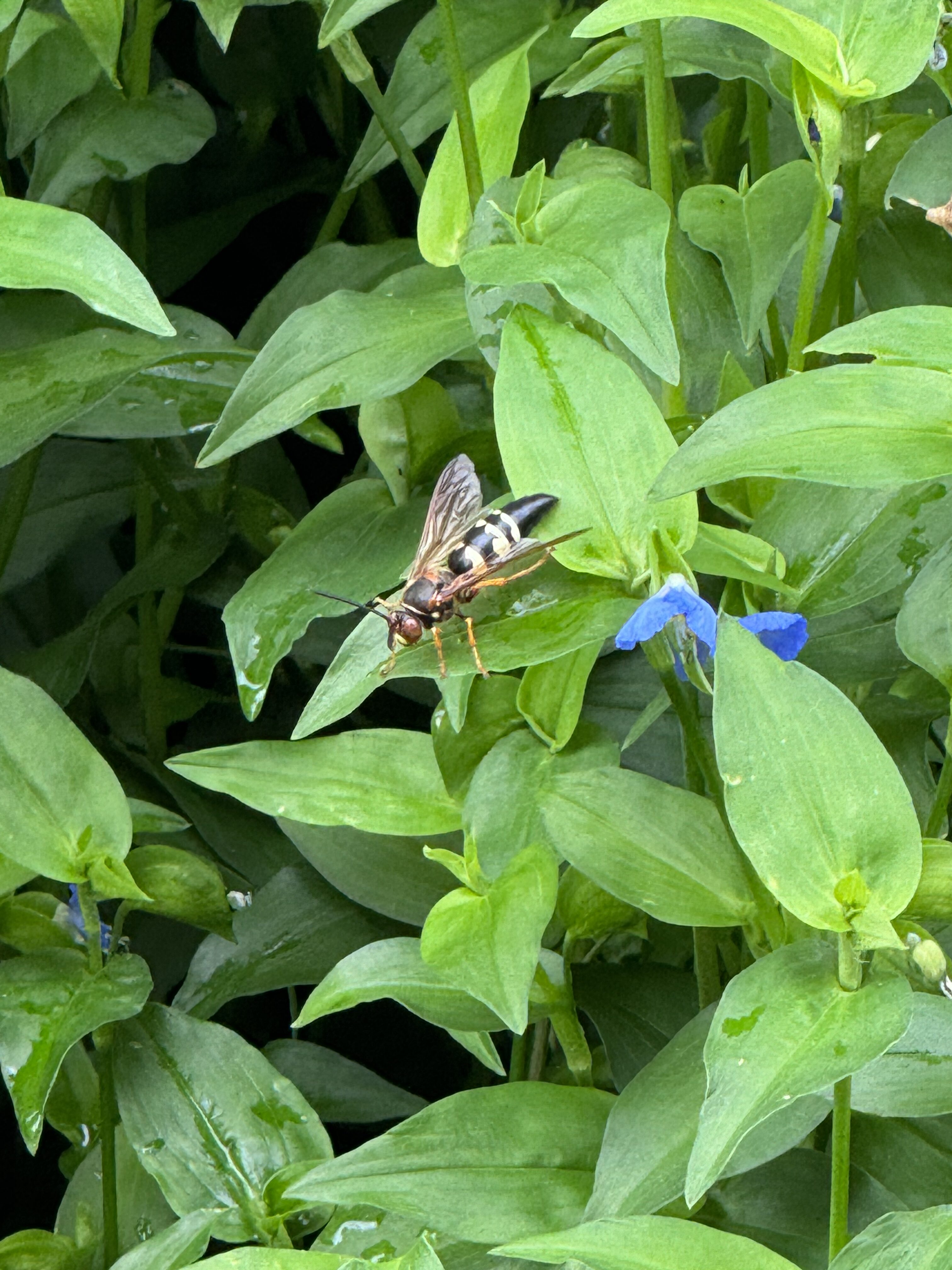
Cicada killers get their name because they hunt cicadas and use them to feed their young. With that in mind, you are most likely to see adults as the cicada population peaks in the summer. They are large wasps that are ~1-2" long with black and yellow markings. We get calls every year that misidentify them as "gigantic yellow jackets". They are also commonly confused with northern giant hornets (formerly Asian giant hornets). The Massachusetts Department of Agricultural Resources (MDAR) has a great blog "Cicada Killer or Murder Hornet" on telling the difference.
Unlike yellow jackets or northern giant hornets, cicada killers are solitary wasps. This means that their nests are not what you probably think of when you imagine a wasp nest - they do not live in colonies. You can still find large numbers of them in the same area, but that is because it is a suitable environment for them. Examples of environments they like are sandy soil - it is easy for them to kick out, and good drainage means their burrows are less likely to flood. Fun fact: each female cicada killer will make her own burrow, and she will put up to three cicadas into it for her young!
How Dangerous are Cicada Killers?
As a kid, I was terrified of cicada killers. I had been stung by yellow jackets enough to have a decent fear of wasps generally. Add in how big cicada killers are, and I would flee at the sight of one alone.
Having learned more about them as an adult, I am no longer worried about them - even when they land on me. Only the females have stingers, and they are very unlikely to sting unless you handle them or step on them.
They are unlikely to sting you, and they are beneficial insects that help control cicada populations. Overall, at Ransford, we would recommend coexisting with them whenever possible.
With that said - it is still a risk assessment. If you have a lot of them in regularly traveled paths and are allergic to bee stings, have young children who like to run outside barefoot, have dogs determined to eat them, etc., you may want to re-evaluate.
How to Get Rid of Cicada Killers?
Professional treatment is an option for cicada killers, but it's important to note that it will only address the burrows that are there right now. If the conditions are ideal for cicada killers, more of them will move in, and they will likely come back year after year. The only long-term solution is to discourage them from burrowing by changing the environment. This can be as simple as installing a tarp over the area when they're active, or as complex as completely changing the type of soil.
About the Author
My name is Caitlyn Richmond, and Ransford has been in my family for generations. I am an Associate Certified Entomologist and hold my certification in Massachusetts for structural pest control (Cat. 41). In the age of AI hallucination and misinformation, we have brought our blog writing fully in-house. For my blogs, information sources are listed in the bibliography at the end. We strive to provide accurate and helpful information. If you find a mistake on any of our blogs, including this one, please reach out to us using the Contact Us form above.
Bibliography
- Mallis Handbook of Pest Control (11th Edition) – Stoy A. Hedges, Dan Moreland, & Stan Cope (Eds.), GIE Media, 2025.
- NPMA Field Guide to Structural Pests (2nd Edition) – Eric H. Smith & Richard C. Whitman, National Pest Management Association, 2007.
- Massachusetts Introduced Pests Outreach Blog – Cicada Killer Season is Here!, Massachusetts Department of Agricultural Resources.